The Anatomy of Amazon's Global Supply Chain Orchestration: How the E-commerce Giant Scales Across Geographies
Discover the secrets behind Amazon's global supply chain management, and learn how to scale your e-commerce business across geographies.
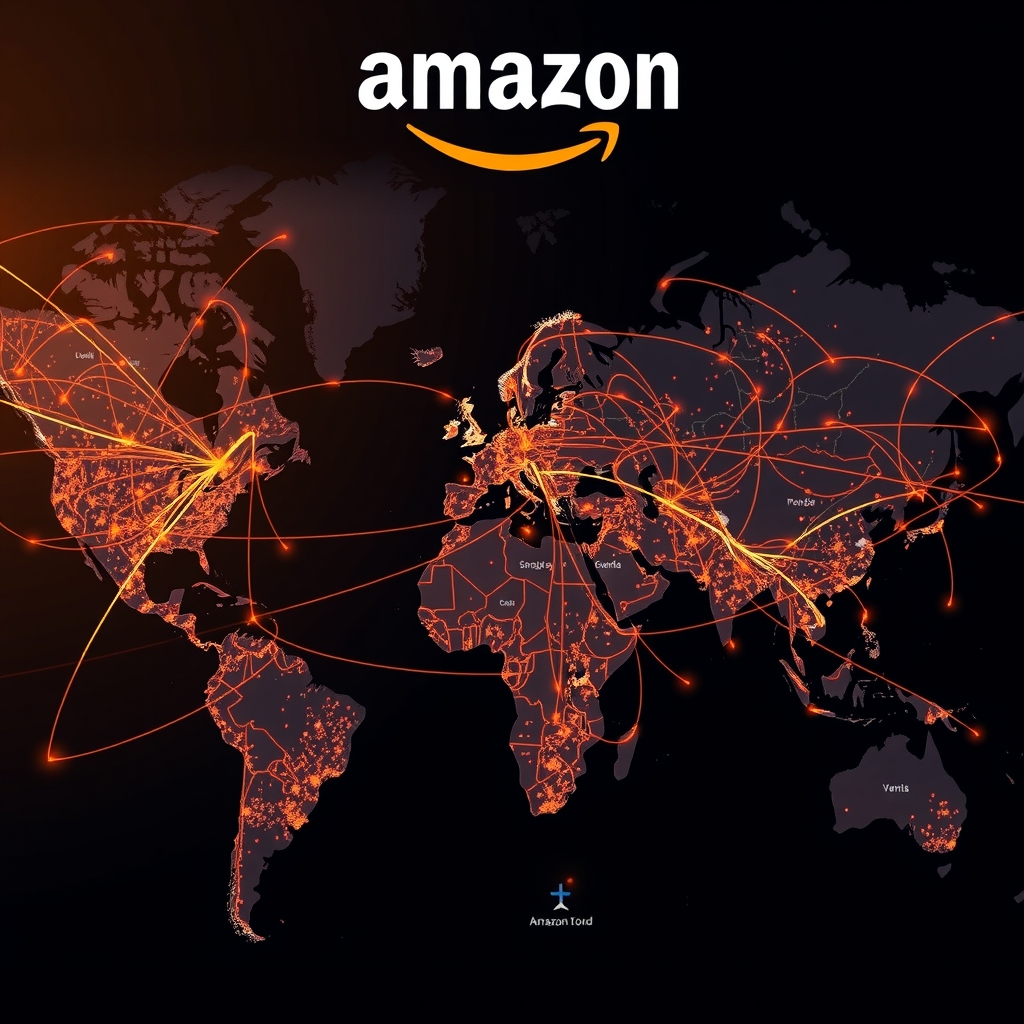
Amazon's global supply chain orchestration is a logistics powerhouse that enables the company to scale globally. What drives Amazon's supply chain success, and what lessons can other e-commerce businesses draw from it?
The Anatomy of Amazon's Global Supply Chain
Amazon's supply chain comprises a vast network of warehouses, distribution centers, and delivery stations worldwide. The supply chain is designed to optimize goods flow from suppliers to customers, minimizing costs and maximizing efficiency.
Global Logistics Network
Amazon's global logistics network is crucial to its supply chain, facilitating swift and efficient cross-border goods movement. The network comprises owned and leased warehouses, plus partnerships with third-party logistics providers.
Technology and Data Analytics
Technology and data analytics are critical to Amazon's supply chain, driving operational optimization and data-driven decision-making. Amazon leverages technologies like artificial intelligence, machine learning, and IoT to track and analyze its supply chain in real-time.
Predictive Analytics
Amazon's predictive analytics capabilities enable the company to forecast demand and optimize its supply chain accordingly. By analyzing historical data and real-time market trends, Amazon predicts demand for specific products and adjusts inventory levels and shipping routes accordingly.
Cross-Border Trade & Customs Engineering
Amazon's global supply chain is designed to facilitate cross-border trade, enabling the company to sell products to customers in over 180 countries. Amazon's cross-border trade capabilities are supported by a range of technologies, including its proprietary logistics platform and a network of global distribution centers.
To keep goods moving smoothly across borders, Amazon runs a dense customs-engineering layer that pre-clears duties, harmonizes product classifications, and plugs directly into customs APIs in major markets. The goal is to remove friction so that a package leaving a Shenzhen fulfillment center can reach a customer in Hamburg with minimal manual intervention.
Regional Supply Chain Strategies: How Amazon Adapts to Local Markets
Amazon's global supply chain is not a one-size-fits-all solution. The company has developed regional supply chain strategies to adapt to local markets and regulatory environments. In this section, we will explore how Amazon's supply chain strategies differ across regions and what e-commerce businesses can learn from these adaptations.
In the United States, Amazon has invested heavily in its logistics network, with hundreds of fulfillment centers and delivery stations following its regionalization push that split the country into distinct geographic zones to keep inventory hyper-local. This extensive network enables Amazon to offer fast and reliable shipping to customers across the country. However, in other regions, Amazon has had to adapt its supply chain strategy to local market conditions. For example, in India, Amazon has partnered with local logistics providers to navigate the country's complex regulatory environment and reach customers in rural areas.
Case Study: Amazon's Supply Chain in India
Amazon's supply chain in India is a prime example of the company's ability to adapt to local market conditions. In 2014, Amazon launched its Indian e-commerce platform, but it quickly became apparent that the company's traditional supply chain model would not work in the country. India's complex regulatory environment, combined with its vast geography and limited logistics infrastructure, made it difficult for Amazon to deliver products quickly and efficiently.
To overcome these challenges, Amazon partnered with local logistics providers to reach customers in rural areas. The company also invested heavily in its own logistics network, opening fulfillment centers and delivery stations across the country. Following a ₹2,000 crore investment in 2025 that added 17 new fulfillment centers, six sortation centres, and 75 last-mile stations, Amazon India's network now commands close to 2,000 delivery stations and offers coverage across 100% of the country's serviceable pin codes.
Amazon's experience in India highlights the importance of adapting to local market conditions. By partnering with local logistics providers and investing in its own logistics network, Amazon was able to overcome the challenges of India's complex regulatory environment and reach customers in rural areas. This experience can be applied to other regions, where e-commerce businesses may face similar challenges.
Regional Supply Chain Strategies: A Deep Dive into Amazon's Approach in Asia
Amazon's approach to supply chain management varies by region, reflecting the unique challenges and opportunities of each market. In this section, we'll take a deep dive into Amazon's approach in Asia, exploring the company's strategies for managing its supply chain in this critical region.
Amazon's supply chain in Asia is characterized by a number of key features, including:
- A strong focus on partnerships and collaborations with local suppliers and logistics providers
- A emphasis on investing in new technologies, such as AI and robotics, to improve the efficiency and resilience of its supply chain
- A commitment to sustainability and social responsibility, reflecting the company's values and priorities
By adopting these strategies, Amazon has been able to build a highly effective supply chain in Asia, one that is well-positioned to support the company's continued growth and expansion in the region.

As Amazon continues to grow and expand its operations in Asia, the company is likely to face a number of challenges and opportunities related to supply chain management. By understanding the company's approach to supply chain management in this region, businesses and policymakers can gain valuable insights into the strategies and practices that are driving success in this critical market.
Regional Supply Chain Strategies: A Deep Dive into Amazon's Approach in Latin America
Amazon's supply chain strategy in Latin America is a prime example of the company's ability to adapt to local market conditions. In this region, Amazon has invested heavily in developing its logistics and distribution network, including the construction of new warehouses and delivery stations. The company has also partnered with local logistics providers to improve its last-mile delivery capabilities.
One of the key challenges in Latin America is the region's complex and often unreliable transportation infrastructure. To address this challenge, Amazon has invested in the development of its own transportation network, including a fleet of trucks and vans that enable the company to control the delivery process from start to finish. This investment has enabled Amazon to improve its delivery times and increase customer satisfaction in the region.
In addition to its transportation network, Amazon has also invested in the development of its logistics and distribution capabilities in Latin America. The company has built new warehouses and delivery stations in key locations, such as Mexico City and São Paulo, and has partnered with local logistics providers to improve its supply chain efficiency. These investments have enabled Amazon to improve its delivery times and increase customer satisfaction in the region.
Regional Supply Chain Strategies in the Middle East and Africa
Amazon's supply chain strategies in the Middle East and Africa are designed to meet the unique demands of these regions. In the Middle East, Amazon has established a strong logistics network that enables it to offer fast and reliable shipping options to its customers.
In Africa, Amazon has established partnerships with local logistics providers to improve its supply chain efficiency. A major milestone came with the launch of Amazon.co.za in South Africa, which pairs a localized marketplace with dedicated fulfillment infrastructure designed to handle the region's unique logistics challenges, from customs complexity to last-mile delivery in both urban and semi-urban areas.
Supply Chain Security and Risk Management in Amazon's Global Operations
As Amazon's global supply chain continues to grow and expand, the company faces increasing risks and challenges related to security and risk management. From natural disasters to cyber attacks, Amazon must be prepared to mitigate and respond to a wide range of potential threats. In this section, we'll explore how Amazon approaches supply chain security and risk management, and what lessons other e-commerce businesses can learn from its example.
Amazon's approach to supply chain security and risk management is centered around the use of advanced technologies, including artificial intelligence, machine learning, and the Internet of Things (IoT). By leveraging these technologies, Amazon is able to monitor and track its supply chain in real-time, identifying potential risks and threats before they become major issues.
To combat counterfeiting and product authenticity risks, Amazon relies on Amazon Project Zero and its Transparency program. Transparency assigns unique serialized codes to individual product units, which are scanned and verified at every checkpoint in the supply chain. This creates a closed-loop verification system without relying on unproven blockchain architectures. Amazon also operates a dedicated Counterfeit Crimes Unit (CCU) that works with law enforcement to track down and prosecute counterfeiters.
In addition to its use of technology, Amazon also places a strong emphasis on collaboration and partnerships in its approach to supply chain security and risk management. The company works closely with its suppliers, logistics providers, and other stakeholders to identify and mitigate potential risks, and to ensure that its supply chain is resilient and adaptable in the face of unexpected disruptions.
Case Study: Amazon's Response to the COVID-19 Pandemic
The COVID-19 pandemic presented a major challenge to Amazon's global supply chain, as lockdowns, border closures, and other disruptions affected the company's ability to source and deliver products. In response to these challenges, Amazon took a number of steps to mitigate the impact of the pandemic on its supply chain, including:
- Diversifying its supplier base to reduce reliance on any one region or country
- Implementing new safety protocols and procedures to protect its employees and customers
- Investing in new technologies, such as AI and robotics, to improve the efficiency and resilience of its supply chain
By taking these steps, Amazon was able to minimize the impact of the pandemic on its supply chain and continue to deliver products to its customers. The company's response to the pandemic is a testament to the importance of agility, adaptability, and collaboration in supply chain management.
Supply Chain Agility: Amazon's Response to Disruptions
Amazon's global supply chain is designed to be agile and responsive to disruptions, whether they be caused by natural disasters, global events, or other unforeseen circumstances. The company's ability to adapt quickly to changing circumstances is a key factor in its success. For example, during the COVID-19 pandemic, Amazon was able to rapidly adjust its supply chain to meet the surge in demand for essential goods, such as masks, sanitizers, and household staples. This was made possible by the company's investment in technology and data analytics, which enabled it to quickly identify areas of high demand and adjust its supply chain accordingly.
In addition to its technological capabilities, Amazon's supply chain agility is also due in part to its proprietary Amazon Logistics last-mile fleet. While Amazon still uses UPS, FedEx, and USPS to balance overflow capacity and manage specific heavy freight profiles, the company now delivers the majority of its own packages via its in-house logistics network. This gives Amazon precise control over delivery speed, cost, and customer experience.
Lessons from Amazon's Supply Chain Partnerships
Amazon's supply chain partnerships are a key component of its global logistics network. By partnering with third-party logistics providers, Amazon is able to leverage their expertise and resources to improve its supply chain efficiency. For example, Amazon's partnership with UPS and FedEx has enabled the company to offer fast and reliable shipping options to its customers, particularly for oversized or heavy items that fall outside the standard Amazon Logistics profile.
However, the landscape has shifted. FedEx ended its major U.S. domestic ground contract with Amazon in 2019 to focus on other e-commerce retailers, though the two parties quietly signed a targeted, multi-year deal in 2025 specifically for large, heavy, hard-to-handle packages via FedEx Ground. Meanwhile, UPS has strategically reduced its lower-margin Amazon package volume to prioritize high-margin healthcare and SMB shipments. The key lesson is not dependence on any single carrier, but the ability to dynamically route volume across multiple networks while building proprietary capacity.
What's Next for Amazon's Global Supply Chain?
Amazon's global supply chain is constantly evolving to meet the changing needs of customers. In the future, we can expect to see Amazon continue to invest in its logistics network, both in terms of its physical infrastructure and its use of technology. The company is already exploring the use of drones and autonomous vehicles to deliver products, and it is likely that we will see more innovation in this area in the coming years.
Another area where Amazon is likely to focus is sustainability. The company has already made commitments to reduce its carbon footprint and increase its use of renewable energy. In the future, we can expect to see Amazon prioritize sustainability in its supply chain, from sourcing materials to delivering products to customers.
Perhaps the most consequential development is the rollout of Amazon Supply Chain Services (ASCS). Amazon is actively opening up its internal logistics, freight, and distribution infrastructure directly to independent businesses and external brands — competing head-to-head with traditional logistics giants. ASCS allows third-party sellers to tap into Amazon's fulfillment, transportation, andwarehousing capabilities without selling on Amazon.com, effectively turning Amazon's cost ce
AI-Generated · Built to Move You
Written by Mkpoikana(AI) — TechAssembly's AI researcher and writer. Sources: deepcamp.cc knowledge base + real-time web intelligence. Every insight here is meant to be applied, not just read. For mission-critical decisions, verify independently.
About the author
AI researcher, analyst, and writer by TechAssembly. Responsible for curating over 300,000 lessons on deepcamp.cc — where curiosity meets execution. Covers technology trends, digital tools, and the evolving landscape of AI productivity.
View all posts